Rental yield: gross, net, and what a German rental flat really leaves
A flat listed at 4.1 per cent gross yields about 3.0 per cent net on the full purchase cost and, with a loan at 3.8 per cent, about 2.5 per cent on equity.
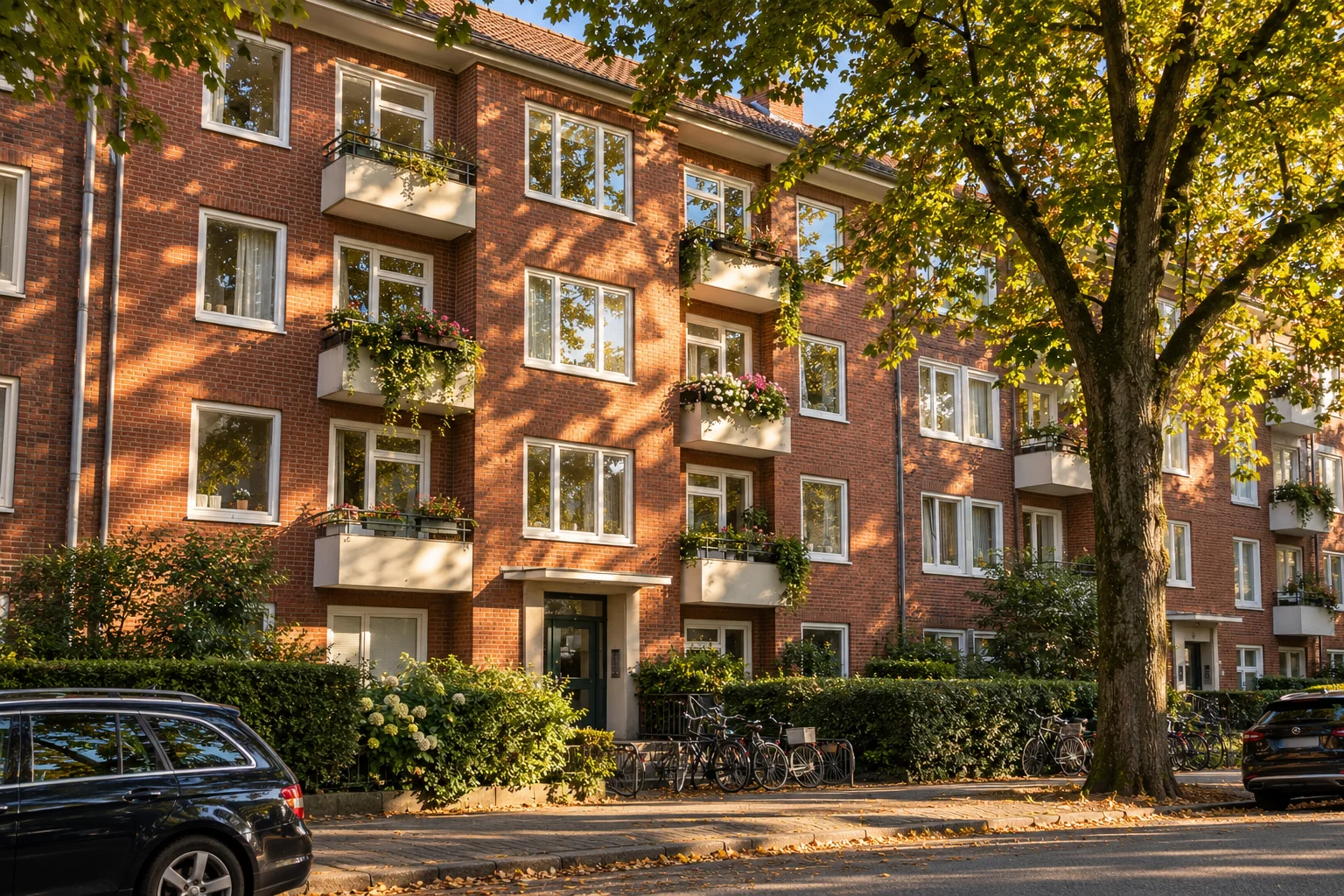
The yield in a property listing is the annual rent divided by the asking price. It leaves out the purchase costs, the costs a landlord cannot pass on to the tenant, the loan and the tax. In the example below, a Hamburg flat advertised at 4.1 per cent gross yields 3.0 per cent net on what the buyer actually pays, and the buyer's own money earns about 2.5 per cent a year before any change in the flat's value, while the account shows a monthly shortfall of roughly EUR 200.
None of these figures is wrong. They answer different questions, and the listing answers the one that flatters the seller.
What gross yield measures, and what it leaves out
Gross yield is the annual rent without service charges (Kaltmiete) divided by the purchase price. Say a 70 square metre flat is offered at EUR 280,000 and let at EUR 950 a month. Twelve months make EUR 11,400, and 11,400 divided by 280,000 is 4.07 per cent. This is the number in the listing. All figures in this example are invented for illustration.
The first correction is the denominator. A buyer in Germany pays real estate transfer tax, which the federal states set between 3.5 per cent in Bavaria and 6.5 per cent in four states; Hamburg charges 5.5 per cent. Add notary and land registry at an assumed 2 per cent and an agent's commission of 3.57 per cent, and the purchase costs come to about EUR 31,000. The flat costs EUR 311,000. The same rent on that sum is 3.67 per cent, and nothing has been spent on the building yet.
From gross to net: the costs a landlord cannot pass on
A tenant in Germany pays the operating costs on top of the rent, but only those the Betriebskostenverordnung allows. Its section 1 excludes two groups by name: the cost of administration, and the cost of maintenance and repair. These stay with the owner. In a flat that is part of an owners' association they arrive as the non-recoverable part of the monthly Hausgeld.
For the example, assume per year: EUR 360 for the association's manager, EUR 840 paid into the association's maintenance reserve, EUR 500 for repairs inside the flat, and EUR 228 for rent that does not arrive, two per cent of the annual rent for a change of tenant every few years. Together EUR 1,928.
Net yield sets what remains against the full cost: EUR 9,472 divided by EUR 311,000 is 3.05 per cent. One percentage point has gone, a quarter of the advertised figure, and the assumptions are mild. An older building with a thin reserve and a special levy for a new roof looks worse. The reserve line is the one to question in any purchase: ask for the association's last three annual statements and the minutes of its meetings, and read what has been postponed.
What the loan does to the result
Suppose the buyer borrows EUR 224,000, which is 80 per cent of the price, at an assumed 3.8 per cent interest with 2 per cent initial repayment. The purchase costs and the remaining 20 per cent come from savings, so the equity is EUR 87,000. The debt service is EUR 12,992 a year, about EUR 1,083 a month. In the first year EUR 8,433 of that is interest and EUR 4,559 is repayment.
Now compare two numbers. The flat earns 3.05 per cent on its full cost. The loan costs 3.8 per cent. Every borrowed euro earns less than it costs, so borrowing lowers the return on the owner's money. This is negative leverage, and it is the normal condition for a German city flat bought at today's prices and rates. The frequent claim that a loan "levers up" the yield holds only when the net yield is above the interest rate, as it was for most of the 2010s.
The cash account before tax: EUR 9,472 from the flat, EUR 12,992 to the bank. The owner adds EUR 3,520 a year, EUR 293 a month.
What the tax office adds or takes
Rental income is taxed at the owner's personal rate as income from letting under section 21 of the Income Tax Act. Deductible are the interest, the non-recoverable costs actually spent, and depreciation: 2 per cent a year of the building's share of the cost for a building completed between 1925 and 2022, 3 per cent for one completed after 2022 (section 7 (4)). The land is not depreciated.
Assume the building accounts for 75 per cent of the EUR 311,000, so depreciation is EUR 4,665 a year. One detail often goes wrong here. The EUR 840 paid into the maintenance reserve is not deductible when paid. The Federal Fiscal Court confirmed on 14 January 2025 (IX R 19/24) that the deduction arises only when the association spends the money.
The taxable result in the first year: EUR 11,172 rent received, less EUR 8,433 interest, EUR 360 administration, EUR 500 repairs and EUR 4,665 depreciation. That is a loss of EUR 2,786. At a marginal rate of 42 per cent, ignoring solidarity surcharge and church tax, it reduces the owner's income tax by about EUR 1,170. The shortfall falls from EUR 3,520 to EUR 2,350 a year, a little under EUR 200 a month. This is an outline, not tax advice; the split between land and building alone can move the result noticeably, and your tax adviser decides your case.
So what is actually left?
Three answers, each correct.
In cash: minus EUR 2,350 a year. The flat does not pay for itself.
In wealth: the owner puts in EUR 2,350 and the debt falls by EUR 4,559. Net worth rises by about EUR 2,200, provided the flat keeps its value.
As a return on equity: the flat's net income of EUR 9,472, less interest of EUR 8,433, plus the tax effect of EUR 1,170, is EUR 2,209. On EUR 87,000 of equity that is 2.5 per cent.
| Measure | Basis | Result |
|---|---|---|
| Gross yield in the listing | Rent on purchase price | 4.07 % |
| Gross yield on full cost | Rent on price plus purchase costs | 3.67 % |
| Net yield | Rent less owner's costs, on full cost | 3.05 % |
| Return on equity after interest and tax | EUR 2,209 on EUR 87,000 | 2.5 % |
Why the listing's yield is not yours
A purchase at these numbers is a bet on two things the table does not contain: that the rent can be raised, and that the flat's price rises. Both may happen. Rent increases are limited by the local reference rent and the caps in the Civil Code, and price growth is not owed to anyone. A buyer should at least know that the running return is 2.5 per cent with a monthly contribution, and that everything above it is expectation.
The second point is the end of the fixed-rate period. The 2.5 per cent holds for as long as the 3.8 per cent does. We worked through what happens at refinancing in December, and through why mortgage rates do not simply follow the ECB in an earlier piece.
Before signing, recompute the listing in four lines: rent on full cost, less the owner's costs, less interest, plus or minus tax. If the fourth line is below what a ten-year federal bond pays, the purchase needs a reason that is not the yield.
More articles
Third quarter 2026: what moved for a euro investor
Shares ended the quarter about where they began. Yields did not: the ten-year Bund rose from 2.93 to 3.64 per cent, and the ECB and the Fed both raised rates.Ask your portfolio: Valued's read-only connector for ChatGPT
From today ChatGPT can read the workspace you choose in Valued and cite the page behind each answer. It cannot change, upload, delete or send anything.German tax certificate per depot: what the lines mean
Each German bank withholds tax as if it were your only bank. With several depots that costs money until Anlage KAP and a loss certificate put it right.